


Beyond Earth: God’s “Outer Space”

SHARE
The heavens declare the glory of God, and their vastness has long stirred human curiosity (Psalm 19:1). From the earliest civilizations, mankind has looked upward, wondering about the mysteries above. Today, our technological advancements allow us to journey farther than ever before, exploring planets, stars, and galaxies. Surprisingly, modern space exploration is not at odds with Scripture; rather, it can be seen as a continuation of the wonder God instilled in humanity, reflecting His majesty and infinite wisdom.
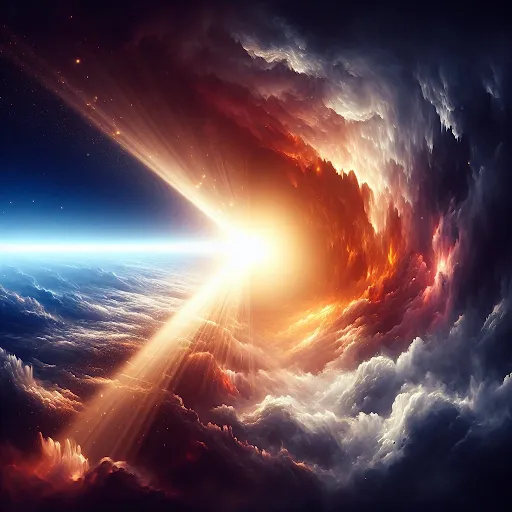
The Bible consistently presents the universe as a deliberate creation, crafted with order and purpose. In Genesis 1:14-16, we read how God set the sun, moon, and stars in the sky to mark seasons and guide humanity: “And God said, ‘Let there be lights in the expanse of the heavens to separate the day from the night…’” This passage underscores a fundamental truth: the heavens are not random, chaotic, or meaningless. Scientific exploration today reveals intricate celestial mechanics and complex planetary systems that mirror the precise order Scripture describes. The more astronomers study, the more they witness a universe finely tuned—a reflection of God’s intelligence rather than a mere accident of chance.
Consider the vast distances and the intricate systems we observe in space. Psalm 8:3-4 marvels, “When I consider your heavens, the work of your fingers, the moon and the stars, which you have set in place, what is mankind that you are mindful of them?” Even as humans reach further into the cosmos, God’s Word reminds us that His creation is immeasurably greater than we can imagine. The pursuit of knowledge through satellites, space telescopes, and interplanetary probes is not hubris; it is an expression of stewardship. By studying the heavens, humanity fulfills the call to understand God’s world, echoing the scriptural mandate to “fill the earth and subdue it” (Genesis 1:28), extending now into the cosmos.
Space exploration can deepen faith rather than diminish it. Observing distant galaxies and the birth of stars can inspire awe akin to the psalmist’s experience. Job 26:7 states, “He spreads out the northern skies over empty space; he suspends the earth over nothing.” Modern astronomy confirms that the Earth indeed floats in the vacuum of space, suspended in a delicate balance—a testimony to God’s precise design. Every discovery of another planet or cosmic phenomenon reflects a Creator whose wisdom far surpasses human understanding.
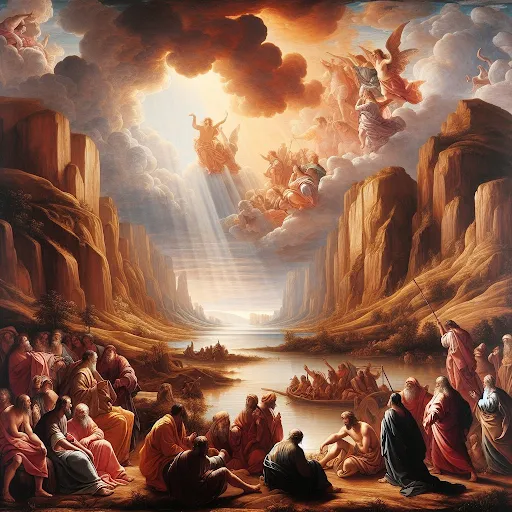
The pursuit of the stars aligns with a biblical view of curiosity, stewardship, and wonder. By exploring the universe, we glimpse the boundless creativity and authority of God. Science becomes not a replacement for faith but a tool to marvel at His handiwork. As we launch rockets, study exoplanets, or gaze into the depths of space, we participate in a centuries-old tradition of seeking to comprehend the grandeur of the One who “made the heavens and stretched them out” (Isaiah 42:5).
Through every orbit and telescope lens, the message remains clear: the universe is God’s masterpiece, vast and purposeful, inviting us to explore and glorify Him.
*All Photos from bibleart.com
RELATED ARTICLES

Were Michael and Uriel Present at the Crucifixion?

Lessons from Jesus Healing the Soldier’s Ear at Gethsemane

What Happened During the Last Supper? Meaning Explained

What Happened to Jesus at Gethsemane? Meaning and Lessons