
Noah’s Ark Site: New Discoveries Beneath the Surface
SHARE
New scans in Turkey reveal rock corridors linked to Noah’s Ark, prompting fresh faith discussions and renewed interest in biblical truth.
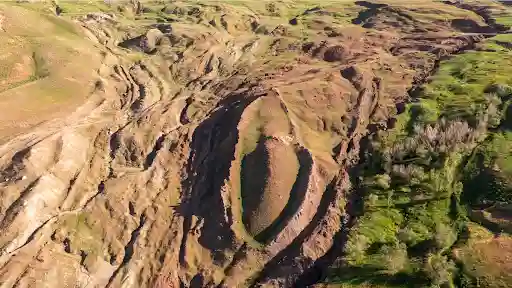
Recent underground scans in eastern Turkey have added a compelling layer to the ongoing search for Noah’s Ark. Researchers studying the Durupinar formation, which is long believed by some to be the Ark’s resting place, have identified a network of unusual rock corridors beneath the surface. Using ground-penetrating radar and advanced imaging tools, the team uncovered what appear to be tunnel-like structures running through the formation, including a central cavity resembling an interior chamber.
These features are not random. According to the research team, the corridors follow patterns that suggest intentional design rather than natural geological formation. The dimensions of the structure also closely align with the biblical description of Noah’s Ark. It is approximately 515 feet in length. This has led some to believe that the formation may preserve the remnants, or at least the imprint, of a massive ancient vessel.
Additional soil analysis has revealed elevated levels of organic matter and potassium within the structure, along with distinct vegetation differences compared to the surrounding area. These findings may point to past human or biological activity, further deepening the mystery.
Faith Beyond Physical Evidence
While these discoveries are intriguing, they remain under scientific scrutiny. Some experts caution that no conclusive proof has yet been established linking the site directly to the Ark. Still, for many Christians, the importance of this story goes far beyond physical validation.
Hebrews 11:1 reminds us, “Now faith is confidence in what we hope for and assurance about what we do not see.” Faith is not dependent on archaeological confirmation. It is rooted in trust in God and His Word. Yet, discoveries like these can encourage Christians and open meaningful conversations about the Bible and the gospel.

The account of Noah ultimately centers on obedience and righteousness. Genesis 6:9 says, “Noah was a righteous man, blameless among the people of his time, and he walked faithfully with God.” Whether or not the Ark is definitively located, this truth remains central to Christian belief.
A Story That Still Points to Salvation
The deeper message of Noah’s Ark continues to resonate today. It is a story of judgment, but also of grace. It is where God provided a way of salvation for humanity. The possibility that physical traces of the Ark may still exist serves as a reminder of the Bible’s enduring relevance and the reality of God’s promises.
As researchers plan further exploration, including the use of robotic probes to investigate the underground corridors, the conversation is far from over. Whether these structures ultimately confirm or challenge existing theories, they invite both the scientific community and the church to engage with humility and curiosity.
For Christians, the focus remains clear. Through prayer and the guidance of the Holy Spirit, Christians are called to anchor their faith not in shifting evidence, but in the unchanging nature of God. The story of Noah still points forward—to redemption, to hope, and ultimately to Heaven through Jesus.
In the end, the Ark’s greatest significance is not where it may be found, but what it represents: God’s faithfulness, His justice, and His saving grace revealed throughout Scripture.
*Cover Photo/Thumbnail Photo From National Geographic
RELATED ARTICLES

PUMA and Rosé Launch Two New Earthy Speedcat Colorways This October

JULIEN’S AUCTIONS ANNOUNCES “PAUL REUBENS’ BIG AUCTION”

Smarter Sports and Health on Your Wrist: HUAWEI WATCH GT 7 Series and HUAWEI WATCH D3 Now Available for Pre-Order Starting at PHP 14,999

CRUNCHYROLL EXPANDS ITS ONE PIECE CATALOG ACROSS SOUTHEAST ASIA